

Written by Chandler Lyon of C.E.L.L. Supplies
Chandler.Lyon@CELL-Supplies.com
Preface
Laboratory incidents are on the rise says one research paper on the topic of laboratory safety. [1] And it seems to be due to negligence, or lack of preparedness. The paper by Wanshu Wang et al. states that one probable reason for this is that modern technology is “advancing scientific research and innovation” and that due to the rate in which technology is progressing in the modern era, laboratories have largely been unable to “keep pace” with the increase in complexity of the experiments.
Perhaps the most concerning part of this increase in injury rate however, is that the majority of injuries do not even happen to research or laboratory professionals, but students (according to a paper that analyzed data from 2001-2014). [2] An article is mentioned in yet another paper. The following quote is discerned from that article and due to its relevance, it is fit to include it here as well: “Universities and their researchers don’t take lab safety seriously, the safety experts say, and nobody has really ever forced them to.
The vast majority of the research institutions and faculty still do not get it….” (article [3], paper [4]). This is a notion that C.E.L.L. Ltd. Co. can certainly assimilate with, though that is an article for another day. It should be noted that the notion of “… research institutions and faculty still do not get it…”, David Rainer, an experienced researcher at North Carolina State University (He was working at NCSU for around 30 years from 1992-2024 before his unfortunate passing in 2024), was largely refuted.
David Rainer states “I disagree. Almost all of our campus leaders, PI’s and students ‘‘get it’’ and we as administrators will use all of our concerted resources to improve our programs.” though it is the opinion of C.E.L.L. Ltd. Co. that the numbers (of which there are few) indicate to the contrary. It is C.E.L.L. Ltd. Co’s opinion that in general, universities and institutions are less concerned with compliance than they are with the repercussions and “fallout” of not meeting said standards. This is not to say, however, that David Rainer’s opinions or ideas are invalid, for certainly they are, and in his paper, he makes considerable arguments that will be weighed in this article.
Lastly, while not constrained to this data set, the focus of this paper is specifically on injuries in university laboratories.
Conflicts of Interest
The Daily Hazard is affiliated with C.E.L.L. Ltd. Co., a manufacturer of laboratory P.P.E. The author of this article was a victim of severe laboratory injury due to faulty protective equipment during a chemical exposure. While The Daily Hazard strives to avoid bias in their articles, the author acknowledges that there may be some degree of bias, particularly in the case of laboratory safety violations.
Definitions
- C.E.L.L. Ltd. Co. – Chemical Experimentation Laboratories and Labor
- P.P.E. – Personal Protective Equipment
- N.C.S.U. – North Carolina State University
- P.I. – Principal Investigator
- et al. – et alia (“and others”)
- STP – standard temperature and pressure (1 atmosphere [or sometimes 1 bar in more modern texts], 0 Celcius)
- RT – Room temperature (20 Celcius)
- n (Sample Size) – The number of observations or incidents included in a dataset (e.g., n = 202).
- J. Chem. Educ. – Journal of Chemical Education.
- J. Chem. Health Saf. – Journal of Chemical Health and Safety.
- Nat. Chem. – Nature Chemistry.
Who Gets Hurt?
Time and time again, it is found that the primary demographic which is injured in university laboratories, is students.[2,5] There may be several reasons for this, though due to limited data collected and shared by universities, speculation is all that is possible. [6] It is mentioned in the paper by A. Dana Menard, and John F. Trant that “… No comprehensive dataset is currently available on the type or frequency of accidents or near-misses in academic laboratories.” (though their citations for that statement, as far as I can tell, are unrelated.)[6] In writing this paper, that is a notion that I seem to agree with. The closest thing that really exists for university related instances is an account of deaths as published in papers, or reported confidentially.(see: https://www.labsafety.org/memorial-wall). Regardless of the lack of data, speculative reasons for the frequency of student injury can be found.
Perhaps the most obvious, number of students, could be a contributing factor. An analysis is conducted in a paper in the Journal of Chemical Health and Safety.[8] Though their data is limited. Their data however, seemed to not find a general correlation between number of students and the injury frequency (per 100 students). In fact, while post graduates and fellows, along with graduate students accounted for the largest number of injury, and the largest number of students, their adjusted injury rate per 100 researchers was less than other staff and faculty. This would suggest, that the reason it is more common to hear about injuries for students is not because students are incompetent, or that they are the most likely to be injured (rather it is their instructors), but simply because they account for such a large portion of university populous.
Thus it is the opinion of the author that normalized data in this specific scenario is unnecessary and possibly misleading given the vast disparity between the population of the students and the researchers, particularly because it frames student injuries as being of lesser importance, when the fact is that students spend more time in the lab, than the majority of other laboratory personnel according to one survey from January, 2016 [9]. Furthermore, given that students are the primary concern at research institutions, and that this paper focuses on injuries at laboratories in general, un-normalized data will be the preferred method of presentation for the remainder of this article.
The paper by Hellman et. al., while fairly old, does this well and provides us with data on students and professors in a laboratory. Out of 544 reported incidents which contained the title of the individual(s) who were injured, over 72% were undergraduates. Graduates accounted for 5%, professors 4%, student workers, associates, and other accounted for 3%. The rest were researchers and maintenance workers. From this data, the following graph can be generated:
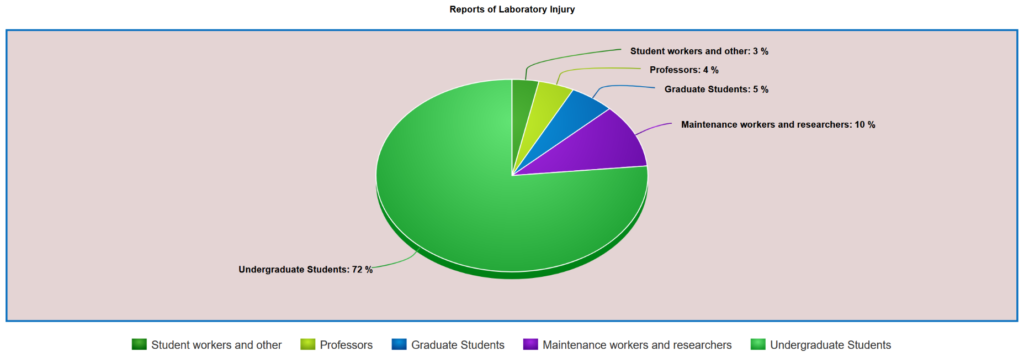
Figure 1: Reports of Laboratory Injury Adapted From Data by Hellman, M. A.; Savage, E. P.; Keefe, T. J. Epidemiology of Accidents in Academic Chemistry Laboratories. Part 1. Accident Data Survey. J. Chem. Educ. 1986, 63 (4), 267. https://doi.org/10.1021/ed063pA267
It can be seen that in general, across a range of even the limited resources available, students account for almost all injuries in university laboratory settings. As for the reasoning for the lack of resources available, it is likely that research institutions do not want to risk legal backlash for incidents in their laboratories. If they can settle, they will as a means to avoid negative press.
What Causes the Injuries?
The topic of what causes injury may seem like a rather trivial one, but it is more complex than meets the eye. It is a question that can be considered in a variety of ways, and for the purposes of the article, we will consider two of them. The first will be physical sources of injury, and the second will be habitual sources of injury. Physical sources of injury would be any tangible object, reagent, reaction, or otherwise conceivable item that can and has caused injury in the past. Habitual sources of injury will be bad practices, mindsets, improper procedures, and other less tangible sources of injury.
Again, the paper by Hellman et al serves well, as it covers reagents involved in chemistry laboratory accidents, as well as the type of equipment involved. For the reagents portion, the following data is adapted from the paper: [5]
Reagents involved in academic chemistry laboratory accidents (n=202):
49% are attributable to acid
39% are unidentified chemicals
6% are water
6% are other compounds
As is evident from this data, acids are one of the most prevalent sources of accidents in chemistry laboratories, with unidentified chemicals being second. These two combined account for nearly 90% of all laboratory incidents. Acids are aqueous solutions, and it can be hard to immediately identify the difference between an exposure to water and an exposure to acid, as, contrary to popular belief, acids do not generally cause pain immediately (at stp, and normal operating concentrations).[8]
Hellman et al also covered the type of equipment involved in laboratory accidents, and from their findings, the following data could be found:
Equipment involved In academic chemistry laboratory accidents (n = 334):
54% are from broken glass beaker or vessel
30% are from broken glass tubing or thermometers
4% are from ring stands
3% are from fire
9% are “other”
From this, we can find that roughly 84% of the equipment involved in these laboratory accidents were glass related. This makes sense when you consider that most chemistry work is done in glass vessels. This is because often, reagents need to be heated and need an inert container to hold them. Fire is often accused of being a major hazard in the laboratory, and while it is, it is much less so than other sources of injury. The author of this article attributes this mostly to the fact that fire is a well documented hazard, and one that everyone is aware of and takes seriously, because we see it in our day to day lives.
The paper by Wanshu Wang et al discusses other potential sources of injury, though without metric. [1] They list Flammable and pyrophoric substances, toxic reagents, corrosive substances, allergens, psychoactive substances, high/low temperature, high pressure or vacuum, electrocution, laser and radiation harm, mechanical injury, microbes, and macro-molecular agents all as being key sources of injury or hazard in a laboratory environment. These are all hazards that need to be noted and accounted for when preparing for work in a laboratory environment. Not all laboratories experience all of these hazards, and it would not make sense for most labs to prepare for unencounterable hazards.
For example, it would be unnecessary for a chemistry wet lab to be equipped with full radio-logical hazard protective gear when they do not encounter these hazards in their field, but the same lab would need to be prepared for exposure to caustic, acidic, or otherwise toxic substances, as those are encountered regularly in the lab. It is imperative that laboratory managers and professionals analyze potential exposures in the lab and provide appropriate P.P.E. as necessary.
This brings us to the next topic- habitual sources of injury. Time and time again, we see laboratory professionals practicing poor laboratory safety practices. Sometimes this is because academics, who have extensive education and laboratory experience, sometimes underestimate the severity of a given hazard, believing their practices to be safe even if it cuts corners with regard to safety. The ultimate truth is that while no one ever should take shortcuts when it comes to safety, many universities and institutions don’t even provide their students with lab coats. Furthermore, the same paper by Huang et al. from 2016 notes that in general, researchers in academic labs (like those in universities) are much less likely to use proper P.P.E. for the hazards they face than industrial labs.[9]
One does not need to look far to find evidence of such negligence in the lab. It is one that’s talked about often, especially after the incident talked about in the Chronicle of Higher Education. [3] The person who was hurt was not just injured, and it wasn’t an isolated incident. UCLA had neglected to provide their students with proper PPE several times. [3] The researched reagent was volatile and combusted in air, and required very special handling, but the student (who was not wearing PPE at the time) was moved into an even smaller lab than she started in. Furthermore, the professor heading the research later admitted that he had never even read proper handling procedures for the reagent, and thought his methods were good enough.
Unfortunately, the 23-year-old died as a result of their injuries, after multiple students already experienced accidents in the same lab, with the same reagent before her. This is not just a case of one-off negligence, but a complete disregard for student safety. It is for reasons like this that illicit doubt about articles such as the one published by D. Rainer. [3,4] But more on that later.
The real tragedy in accidents like these is that it isn’t as if the reagent experienced some unexpected reaction, or that the research institution provided PPE that they thought was sufficient. It is an experience that should have been completely and entirely avoidable. And that is exactly what many researchers thought after the incident happened, but unfortunately, it would appear that it is not the case. While Rainer published an article explaining the safety resources made available to students, it did not make any direct claims or provide direct information to students as to what they should do to maintain laboratory safety.
They do have a chemical hygiene plan accessible at a different link than the one in the article (which is likely outdated by now) https://ehs.ncsu.edu/safety-manuals/, which details safety resources for a wide range of topics, but all of these documents are inaccessible to the public and require administrative approval prior to reading.
These are all things that only make following safety standards accessible for students. As a result, evaluating the effectiveness of NCSU’s safety procedures from an external perspective is impossible, since the materials needed to do so are not publicly available. NCSU did not respond to a request for incident history data or access to their safety manuals (when made from a .edu email address).
How do Institutions Respond?
For this section, we will primarily focus on UCLA as they were the institution that the unfortunate student who passed away attended. And to their credit, UCLA appears to have made considerable changes to its safety programs and the accessibility of necessary equipment, particularly for students. They now offer a payment sharing program to help provide PPE, though their stock is limited.[10]
However, the “current inventory” button is not accessible to the general public, so the author of this article signed up for a box account using business credentials, and when they viewed the current inventory on Feb. 17, 2026, the files were shown to have been removed. As a result, it is unclear if this program is still in place, or if anyone can actually apply to receive funding to obtain P.P.E. They do still offer a labcoat laundering program free of charge though. [11] UCLA has begun spontaneous laboratory investigations to determine if labs are compliant with their current lab standards. [12]
There are still laboratories found to not be in compliance with safety standards, but unlike most other institutions, UCLA makes these metrics publicly available, to some degree. It is clear that some number of labs are following the procedures set forth by UCLA, but it is also clear that many are not. Whether or not this has had any impact on the injury rates at UCLA (or other universities) is unclear because they do not publicly report this information (like most universities).
As we saw with the incident at UCLA, institutions only really seem to take drastic measures to adhere to safety procedures when severe incidents (sometimes death) occur. This is simply unacceptable, and one of the main reasons that papers like the one published by Rainer are problematic. While they provide useful resources, those resources move, and they don’t stop injuries before they happen. Students don’t want to get hurt, they don’t want to die, but students are often not able to afford day-to-day things, with more than half of all students reporting that they have experienced some sort of basic needs insecurity (according to a survey from 2023-2024). [13]
Individual students simply cannot afford P.P.E., and if a university cannot provide them to students, they should not be conducting experiments that require them. Most universities do not provide P.P.E, and the ones that do usually offer it in the form of some cost-sharing program, which is still inaccessible to many students who already experience some form of economic insecurity. A lab coat, which is discounted 50%, can cost a student between $40 and $100 for appropriate chemistry P.P.E. (price estimated from multiple sources on Feb. 17th 2025, only P.P.E. that was Fire resistant, chemical resistant, and made out of a non-polyester/melt-able material was considered).
The general consensus of universities is that lab coats and P.P.E. are the responsibility of the student, not the institution that requires them to expose themselves to hazards in chemical labs. But if that’s true, why do institutions provide gloves, glassware, and everything else that the student needs to conduct the chemistry work? Those are all the responsibility of the institution, but safety appears to come second to costs incurred by the college- until someone is severely hurt or killed, that is.
How can you be safe in the lab?
This article has detailed lots of ways you can be unsafe in the laboratory. We have talked about plenty of sources of injury, as well as systemic problems regarding the safety and accessibility of P.P.E. for students. When all this information is considered, there are plenty of options to improve your safety, such as buying a lab coat, ensuring you are reading your SDS sheets, SOP’s, and other relevant literature, ultimately it comes down to a mindset.
There really is no such thing as “close enough” with laboratory safety. P.P.E. is a major problem, but P.P.E. is not a new thing. The issue is one of culture, habit, and what’s considered standard practice in modern academic laboratories. The biggest thing you can do to help safety culture is to hold your institution accountable, and if you are a member of the administration in an institution, contact your labs and ensure they are maintaining proper safety procedures. Government grants exist that can be used to supply students with proper P.P.E.
That said, the following comes with a conflict of interest disclaimer. C.E.L.L. Ltd. Co. is a website dedicated to providing individuals and universities with high quality, and affordable laboratory protective equipment. Priced at just $75, Lumek™ MKII coats are one of the most affordable and reliable lab coats you can find, and they can be purchased here. As far as coats not manufactured by CELL, if you would like to purchase a lab coat that will still keep you safe in most modern chemistry labs, this lab coat by a company completely and entirely unaffiliated with CELL Ltd Co, Novarlo, will do just that. They can be found at www.Novarlo.com
Remember to evaluate your hazards in the lab BEFORE setting foot in the lab. If you ever feel unsafe in your laboratory, speak up! No lab should ever make you feel uncomfortable, and if it does, it is almost always a feeling shared by your peers.
References:
- Wang, W.; Su, Y.; Cao, H.; Li, D. “Enhancing Chemical Laboratory Safety with Hazards Risks Mitigation and Strategic Actions.” Laboratories 2025, 2, 5. https://doi.org/10.3390/laboratories2010005
- Simmons, H. E.; Matos, B.; Simpson, S. A. Analysis of Injury Data to Improve Safety and Training. J. Chem. Health Saf.2017, 24 (1), 4–11. https://doi.org/10.1016/j.jchas.2016.03.004.
- Chronicle of Higher Education. Criminal Charges at UCLA Focus on Safety in Labs. Available at: https://chronicle.com/article/Criminal-Charges-at-UCLA-Focus/131537. (accessed February 10th, 2026).
- Rainer, D. Laboratory Accidents and Safety Program Review. J. Chem. Health Saf. 2012, 19 (5), 58–59. https://doi.org/10.1016/j.jchas.2012.07.007
- Hellman, M. A.; Savage, E. P.; Keefe, T. J. Epidemiology of Accidents in Academic Chemistry Laboratories. Part 1. Accident Data Survey. J. Chem. Educ.1986, 63 (4), 267–270. https://doi.org/10.1021/ed063pA267.
- Ménard, A. D.; Trant, J. F. A Review and Critique of Academic Lab Safety Research. Nat. Chem. 2020, 12 (1), 17–25. https://doi.org/10.1038/s41557-019-0375-x
- Gosavi, A.; Schaufele, M.; Blayney, M. A Retrospective Analysis of Compensable Injuries in University Research Laboratories and the Possible Prevention of Future Incidents. J. Chem. Health and Safety 2019, 26 (2), 31–37. https://doi.org/10.1016/j.jchas.2018.10.003.
- NileRed. Pouring Different Acids on My Hand; YouTube, n.d. https://www.youtube.com/watch?v=eyMR08ZVbNY (accessed 2026-02-14).
- Schröder, I.; Huang, D. Y. Q.; Ellis, O.; Gibson, J. H.; Wayne, N. L. Laboratory Safety Attitudes and Practices: A Comparison of Academic, Government, and Industry Researchers. J. Chem. Health Saf. 2016, 23 (1), 12–23. https://doi.org/10.1016/j.jchas.2015.03.001
- UCLA Environment, Health & Safety (EH&S). PPE Lab Coat Distribution Program. https://ehs.ucla.edu/research‑safety/ppe‑distribution‑program (accessed February 17 2026).
- UCLA David Geffen School of Medicine. Lab Coat Laundry Policy. https://medschool.ucla.edu/research/research‑infrastructure/research‑safety/lab‑coat‑laundry (accessed February 17 20 26).
- 10 Years After Sheri Sangji’s Death, Are Academic Labs Any Safer? Chem. Eng. News 2019,* 97** (1). https://cen.acs.org/safety/lab‑safety/10‑years‑Sheri‑Sangjis‑death/97/i1
- Most College Students Experience Basic Needs Insecurity. BestColleges.com. https://www.bestcolleges.com/news/most‑college‑students‑experience‑basic‑needs‑insecurity/ (accessed February 17 2026).