C.E.L.L. LTD. CO. / THE BUZZ FUNDRAISER
A little buzz. A bigger purpose.
The Buzz is a floral, sour, brandy based cocktail designed to help support the people and research behind C.E.L.L. Ltd. Co.’s Lumek™ laboratory coats. Our mission began as a goal to improve laboratory safety and since then has grown into a hands on development of proprietary early warning dyes and flame resistant textile treatments. This mission is partially inspired by the C.E.O.’s personal experience with laboratory injury, both to himself, and with his peers through academia.
The coat behind the cause
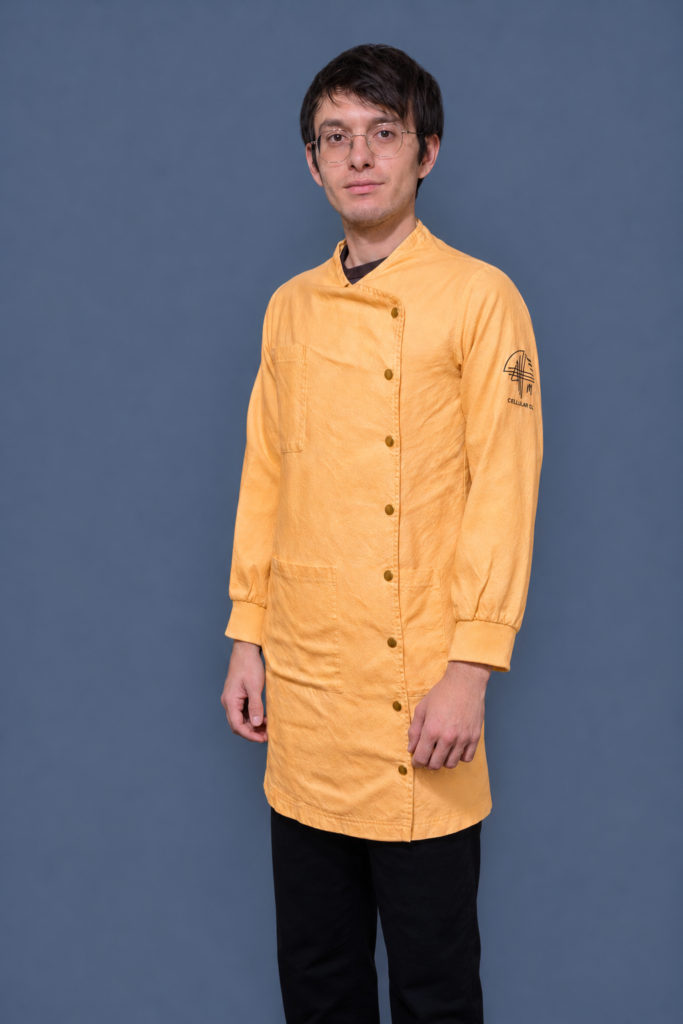
At first glance, Lumek™ is a light yellow laboratory coat with an asymmetrical snap front design. The color was chosen to be light enough to see spills of non-protic reagents, but vivid enough to make spills of hazardous protic reagents. It also retains practical pockets, with an interior pocket for sensitive devices or other personal belongings that should not be exposed to laboratory environments. For added safety, it also possesses knit cuffs. The offset snaps are a functional and aesthetic choice. By overlaying the two sheets of fabric on top of each other, the hazard of liquid reagents seeping past the snap buttons is massively reduced. The more important story though, lies in the textile technology developed to go with it.
Our mission is to make laboratory hazards easier to recognize and to revolutionize laboratory workwear. That means combining visible chemical exposure warnings with research backed approaches to flame resistance, without losing sight of how a coat must function in everyday laboratory work.
Why early warning matters
Academic laboratory research shows why faster recognition of chemical contact matters. In a Canadian pilot study of chemistry and biochemistry students and postdoctoral researchers, 48.8% of the accidents described involved chemical spills or toxic materials, including incidents involving strong acids, strong bases, and solvents. These findings illustrate how frequently chemical exposure can feature in reported laboratory accidents. Ménard, ACS Chemical Health & Safety (2022).
A separate survey of chemistry teaching laboratories in Nepal found that acid-related injuries were the most frequently reported type among 52 accident and hazard examples provided by respondents, with 11 involving improper acid handling. The study specifically noted injuries affecting both clothing and skin. Kandel, Neupane, and Giri, PLOS ONE (2017).
That need for rapid hazard recognition is central to Lumek™. Our proprietary indicator dyes provide visible early warning responses to hazardous acidic and basic chemical exposures, which ultimately helps wearers notice contamination and take action sooner. Every second matters. The studies describe particular surveyed populations, rather than establishing a universal ranking of all laboratory injuries.
Early-warning chemistry you can see
A chemical exposure is not always immediately obvious. C.E.L.L. Ltd. Co. has devoted extensive research to developing dyes that visibly respond to targeted chemical exposures, creating an early-warning indicator intended to help users recognize contact and act sooner.
The dye technology works: our testing has produced strong, clearly visible responses. Reaching that point required repeated experimentation with how an indicator behaves when incorporated into fabric, how readily its change can be recognized, and how the textile performs as a whole. The exact dye formulations and development methods remain proprietary.
Flame resistance backed by testing
Alongside the indicator work, we developed textile treatments focused on improving flame-resistant performance. This was not just a theoretical objective: our treatments performed well in ASTM flame tests. These experiments provided encouraging measured evidence for the protective approaches we are developing.
The research also reflects the challenge of bringing multiple capabilities into one garment. A treatment must work with the fabric and the indicator, and its results must be evaluated rather than assumed. We have used that experimental evidence to refine the design and strengthen the technology behind Lumek™.
The work behind the coat
Lumek™ is the result of extensive independent research, prototypes, setbacks, refinements, and successful experiments. The achievement is not simply an eye-catching garment: it is the development of functional textile technologies aimed at practical laboratory safety problems.
We believe that research deserves to be seen. The Buzz helps introduce the project to a wider community, allowing a simple cocktail to start a conversation about science, invention, and the work required to bring new protective products forward.
Meet The Buzz
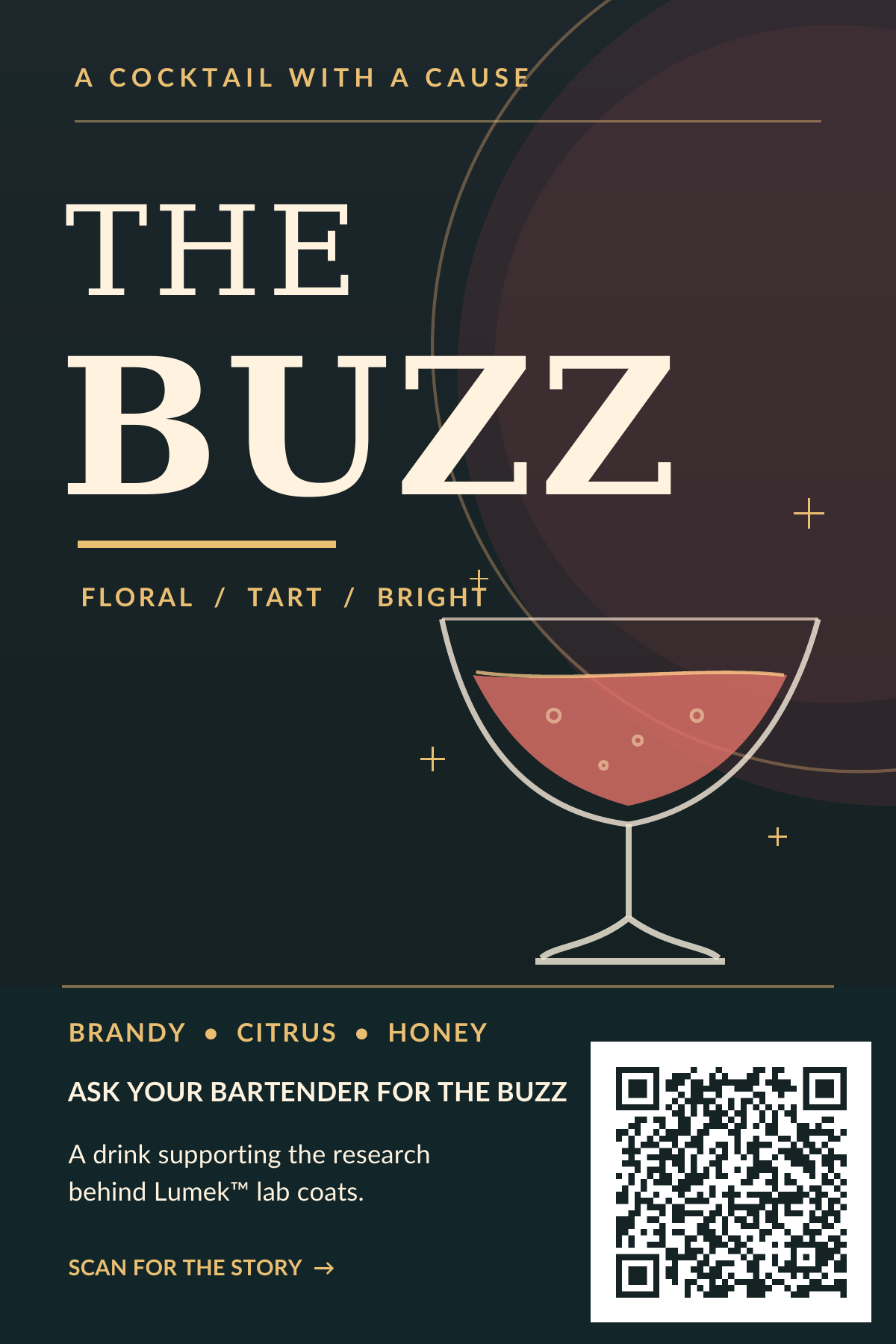
Lemon, honey, E&J brandy, Sarti, aromatic bitters, and cherry bitters—bright flavors supporting a larger purpose.
Participating venue, dates, and the exact amount or portion supporting the project will be added when finalized.
Discover Lumek™
Explore the MKII Lumek™ lab coat, learn more about our chemical-exposure indicator technology in the Lumek™ FAQ, and discover how C.E.L.L. Ltd. Co. is bringing original research into laboratory workwear.
Performance statements reflect the specific exposures and tests evaluated; ASTM-method testing should not be confused with independent certification of a finished garment. Indicators supplement—not replace—appropriate PPE selection and laboratory safety practices.